by Leanna Renee Hieber
When I began my fiction publishing career in 2009, I was writing gaslamp fantasy fiction; cross-genre books with various Gothic, horror, suspense, and romance elements. If you’d told me then that nonfiction would later become a load-bearing tentpole of my artistic three-ring circus, I’d have been surprised to hear it. My brain is so nonlinear, how could I possibly write nonfiction?
I was no stranger to research. All my books are set in as historically accurate a late 19th century as I can manage, with fantastical elements seeping into a gilded age, but nonfiction still felt daunting in comparison. I was worried that I wouldn’t make sense if I wrote nonfiction. Fiction always felt safer to me, and of course it does: it’s a place where the writer can make all the rules. However, in this unsettling century, there is quite a lot to say about how past patterns mirror our current realities, so when a new door of opportunity opened, I decided I’d be wise to walk through.
What opened that portal between writing worlds was the fact that I’m a licensed NYC tour guide. I’m passionate about historical sites and the ghost lore attached to them. An editor familiar with my fiction came along on one of my Boroughs of the Dead ghost tours and said I should consider trying out a nonfiction project related to those very evident passions. Ghosts have always been my raison d’etre. As Boroughs of the Dead was founded by talented writer Andrea Janes, who is similarly driven to do right by history and ghost lore, co-authorship was a must. I couldn’t imagine the work otherwise. We co-authored several chapters detailing sites where we had a great deal of experience and then covered additional ground by writing chapters on our own, allowing our respective voices to take on pet projects, locations, and people.
Because the nonfiction was tied to something I was actively engaged in, being a tour guide helped chart my narrative nonfiction course and my voice on the page. Already performatively engaged in nonfiction storytelling, I translated that to the page and led the reader through locations as if I were doing so aloud and in person, with more of a scholarly paper trail along the way to make sociological points land with the weight they deserve. I’d already begun convention-circuit lectures on the importance of Spiritualism and ghost lore in regards to women’s history, and Andrea had already created a landmark, first-of-its-kind ghost tour focusing only on women’s spirits. The pieces were in place and that’s how it’s continued. Andrea and I were recently interviewed by a journalist about our process and we mentioned we hadn’t come to our nonfiction writing from nowhere. We’d had over a decade of experience on the ground.
I’d urge anyone considering writing nonfiction to pinpoint what experience you have on what ground. Whether you’re querying academic presses or popular narrative nonfiction markets, why do you want to talk about your pet person/place/event? What’s your angle? A distinct, personal through-line hones your pitch and your thesis statement. This holds true for fiction and nonfiction: what does the door into your book look like and what holds that structure up on the inside? What’s your project’s raison d’etre beyond vibes alone? If I haven’t figured that out, if I haven’t pinpointed what makes the book’s heart really beat, then it won’t get beyond an initial read by anyone because it doesn’t have the necessary spark of life. I have plenty of trunked manuscripts where I never quite figured out that vital animating force.
I worried that the shift back to writing full-length fiction after several years of focusing on nonfiction would feel jarring. But it turned out that my fiction had just been patiently waiting, listening, taking the threads of nonfiction research and weaving ideas on its own. I’m admittedly nervous about the reception of my next novel, wondering if my fiction readers will still be there for me. But the themes I’m returning to are very on-brand. My projects are recognizably and authentically unsurprising: I’m a Cancer sign and my artistic tides have always been governed by a Gothic moon. So far, readers of my fiction have gravitated to my nonfiction, and we’ll see if the reverse is true. My personal dialogue with the spirit world remains the same regardless of what I’m writing because I’m always communing with the dead.
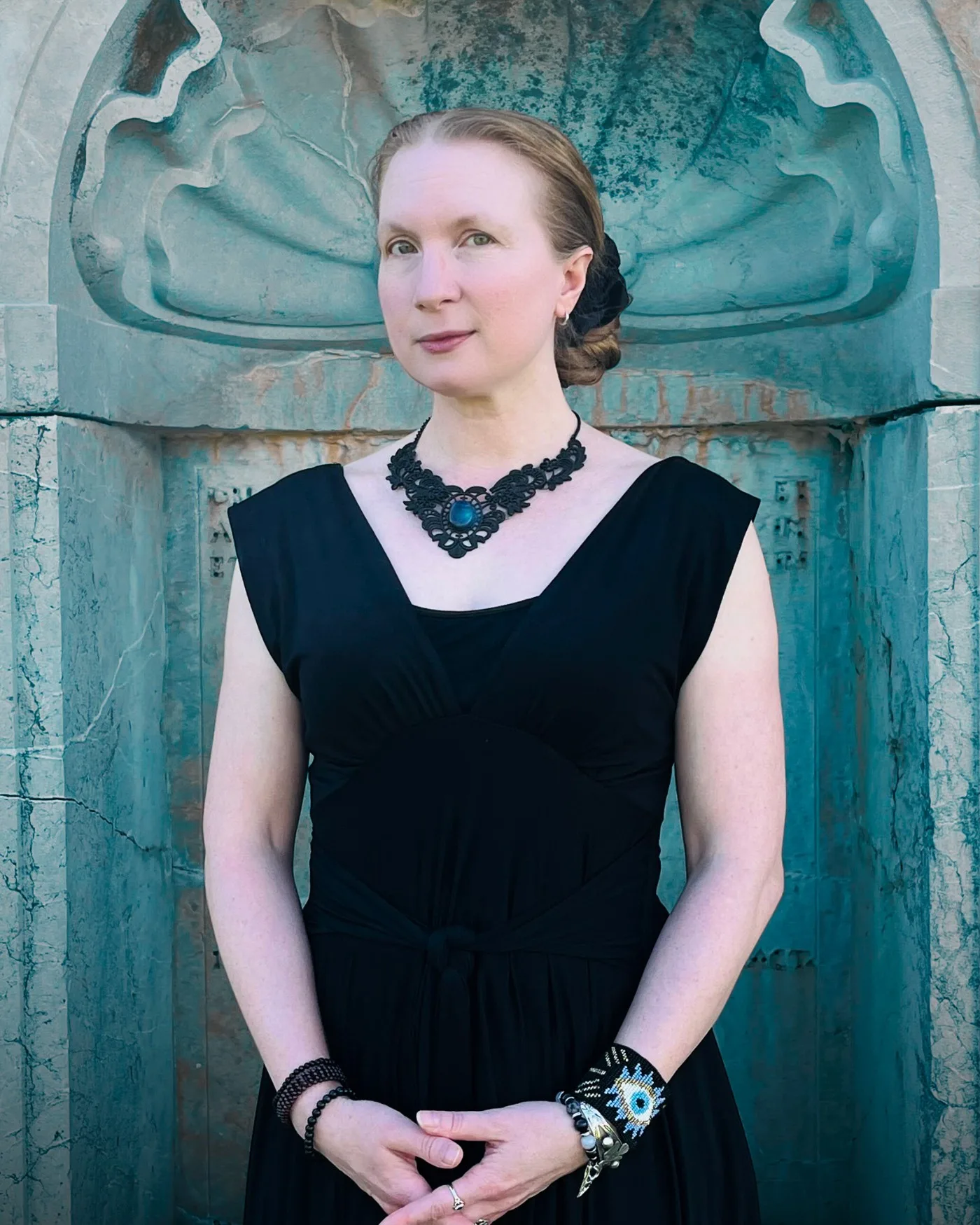
No matter if a project is fiction or nonfiction, it does help when it is authentically, recognizably you. I’ve never known how to “write to market”: it just so happens that Gothic subjects are of interest right now. If you’ve met me, you also know that I dress for the job I want and look more like a Victorian widow than any sort of modern figure. Whether the Gothic has been trendy or not, it’s just me. For years, my line has been, “if you like my clothes, you’ll like my books: I dress like I write,” and that’s been surprisingly helpful in my readership finding me. But any style, look, or branding has to be comfortable for you; it must be authentic, genuine, and enjoyable if it’s something you hope to maintain. At first people might wonder if I’m in costume, but give me about a minute of your time and you’ll realize that no, I’m just… like this. Extrapolate this “look” to fiction, nonfiction, playwrighting, acting, audio narration, and tour guiding and you’ll see it’s all interconnected by design and by desire.
Style, interests, expertise, and hyper-fixations: that’s what floats between the worlds of fiction and nonfiction. When each informs the other, you won’t feel pulled in opposite directions. It doesn’t matter if that connective tissue is obvious to others or not: as long as you know your own association matrix, the information flows between projects without interference.
I don’t know any writer that doesn’t have more than one project in the works, usually in various stages, and I’ve tried to use this to my advantage when moving among the in-between stages of drafting, editing, revising, and while enduring the wait-times of traditional production. It’s always a matter of time.
Let’s be honest: it’s never been easy to be a freelancer in the arts and that is especially true right now. Our time is simply not properly valued. So, for research-heavy work (as any nonfiction has to be, by nature), I suggest working smart; see what can serve double duty. I gravitate to what I hunger to learn more about, because even if those delicious deep-dive details don’t make it into any manuscript, I don’t resent time sinks when the subject emerges into obsession. Seek information that will help you make decisions about the angle, trajectory, setting, and critical details of more than one project at a time. Let yourself go deeper than skimming so you’re not overbroad, but dive in only when you feel there’s a deep well. Don’t sweat dead ends in your research process. Keep swimming rather than digging in vain.
Core details and foundational research that dovetail two projects become islands helping you cross vast watery depths. Example: America’s Most Gothic research carried me directly into what will be my forthcoming Gothic novel, Ravenfield Hall. The Gothic novels, narratives, historical research, and, most importantly, the ghost ships discussed in America’s Most Gothic proved formative and inextricable from the life of Ravenfield Hall.
Stylistically, it’s been interesting, and entirely happenstance, that my previous nonfiction work and my return to full-length fiction are all being written in first person. The nonfiction is my voice guiding you through the narrative of my solo-written chapters; the fiction is the voice of my heroine in her first-person narrative. That’s where my theatre background comes in. Taking on the character in fiction feels entirely natural and familiar to me as an actress.
An important aspect of nonfiction writing is establishing for the reader why they should care about the subject at hand. That means creating a compelling setting and the suggestion of “character” like you would in fiction. However, I try to be careful not to speak for the historical figures I’m writing about. There, I only use first person for my own personal experiences and thoughts on the material, but a writer has to create someone for the reader to root for, so setting and character are important across both categories of writing. Trying to place the reader into the context of the work is vital no matter the genre, but in nonfiction greater care, nuance, and understanding are required. We can speak for our fictional characters at any point. We cannot speak for the actual dead unless we are quoting documented words spoken or written during their lives. Instead, we can become advocates lifting up a lamp to examine what has been hidden or whose histories have been rewritten.
Being an interdisciplinary storyteller has meant that I’m never at a creative loss. There’s always a way into some form or format, always a way to relish the thrill of telling the next tale. For those of us working in historical contexts, the excitement of an old, possibly forgotten thing resurrected for new eyes is the eternal flame we tend. Keeping something alive that otherwise would have vanished from public knowledge—or never have been seen in the unique light that you see it in—is a sacred commitment. Don’t we all want to be seen for the multitudes we are? That’s more important now than ever, as information, truth, and history are being suppressed, controlled, rewritten, and erased. (The loss of archival access, collections, and information is a ghost story for another day, but I remain haunted on a regular basis by historic documentation being so fungible, fragile, and unprotected.)
Our personal viewpoints are a gift. Human uniqueness and varied experience can never be replicated by machines nor from one person to the next. No lived experience is a monolith. Therein is the way forward and the way between all kinds of creativity.
What floats between worlds is you and what you love. You’re the axis, you’re the hub, and may every story that spins out from you keep expanding with knowledge and experience. May your momentum remain steady as myriad paths reveal themselves along your storied way.