By Sophia Adamowicz
You’re a stranger in this place. The locals can tell as soon as polished vowels roll off your tongue, interrupting gruffly mumbled gossip. Eyes cut you down to size. Smirks are passed around the room, and you’re outside the circle, too self-conscious to do as a vampire would and simply ask to be let in. They wouldn’t want you, anyway. Not in one piece.
At eighteen, I left the north of England for Cambridge. Twenty years later, nothing about me hints at my upbringing in Sheffield, the country’s ‘steel city’. At a recent gig by the Sheffield band, Pulp, I asked the barman for a dry-hopped IPA instead of a lager. He looked at me like I’d stabbed his mother. Further along, one man was ribbing another for not sounding northern enough: “You’re too posh, mate!” As discretely as possible, I added a G&T to my order and, after an agonising, semi-whispered argument about whether the stuff he’d put in the drink was gin or rum (it was rum), I scurried away, one of Pulp’s most famous lyrics teasing me. Everybody hates a tourist.
I’m not a tourist, not really. I was born and bred in Sheffield. But to feel a sense of belonging in the place of my birth, I have to dig beneath the surface and find what lurks in home soil. I have to go back to my dark roots.

Folk horror lends itself to explorations of identity—the burning pyre of the genre has long been fuelled by the conflict between insiders and outsiders. Think of the silence that falls upon The Slaughtered Lamb when two American hikers arrive in An American Werewolf in London, or Shirley Jackson’s ‘summer people’ who stay past Labor Day and are punished for presuming that seasonal tourists, whose easy lives depend on the toil of native residents, can blend into the community. In this type of narrative, the threat of the cosmopolitan intruder is neutralised through a collective act—be it sacrifice, storytelling or abandonment to the elements—that reinforces traditional values.
The stereotype of the pitchfork-wielding villages leaves the genre open to criticism: is it not regressive to portray rural people, often working class, as homicidally hostile to external forces? Stories can be particularly troubling when the source of evil is othered not only by stereotypes of class, but of race, as in Arthur Machen’s Victorian faerie horror, ‘The Shining Pyramid’. Modern writers and filmmakers of colour, however, have used folk horror to explore the complexity of the monstrous other. Nikyatu Jusu’s Nanny (2022) portrays Mami Wata’s temptations of ‘sexuality, money and promises of fertility’ as weapons wielded not by the African water spirit, but by the wealthy US family who casually exploit their Senegalese employee. In Coogler’s 2025 Sinners, the Caucasian vampire Remmick is an Irish immigrant, angry at the subjugation of his home country by the British. Yet he wishes to appropriate what is of use to him from the Black community of Jim Crow-era Mississippi—his utopian vision of a vampire collective that erases racial difference is ironically another form of colonialism.
Folk horror often collapses the simple dichotomy of ‘us’ and ‘them’. Outsiders can become the ultimate insiders: take The Wicker Man’s Lord Summerisle, a non-native who persuades the islanders to adopt his system of ritual sacrifice. He secures his place at the top of the social hierarchy through constructed lore. And yet, does he not embody the carnival spirit that liberates the residents of Summerisle from the restrictive mores of mainland police officer Sergeant Howie?
Conversely, an insider may resist the story drummed into them by the rest of their family. Lucy Rose portrayed Margot as an outcast within her own household in The Lamb, attracting a community of readers who can relate Margot’s alienation to their own experiences of prejudice. In my own folk horror novel, The Brink, the protagonist feels ostracised by her family and can only find belonging with a stranger who shuns social convention.
An outsider may also be bound to their community by blood, no matter how much distance they put between themselves and their home. In Natasha Carthew’s story, ‘The Keepers’, Ruvanes returns to an isolated island from her childhood and discovers she is key to its heritage and future survival. As deliciously demonstrated in Daniel Draper’s ‘Perpetual Stew’, someone who has stayed in the same place all their lives may not share the values of a community, whereas an apparent interloper might be the very person to keep traditions going. Both of these stories appear in the anthology of working-class writers, Bog People. Many tales in this volume recognise the source of evil as capitalist exploitation, and although the villagers may still wield pitchforks, they are stabbing into the swollen belly of injustice. Those who leave their native lands and later return are welcomed back into the fold, where they are given the freedom to rail against the true outsiders—the faceless corporations that deracinate regional identity.
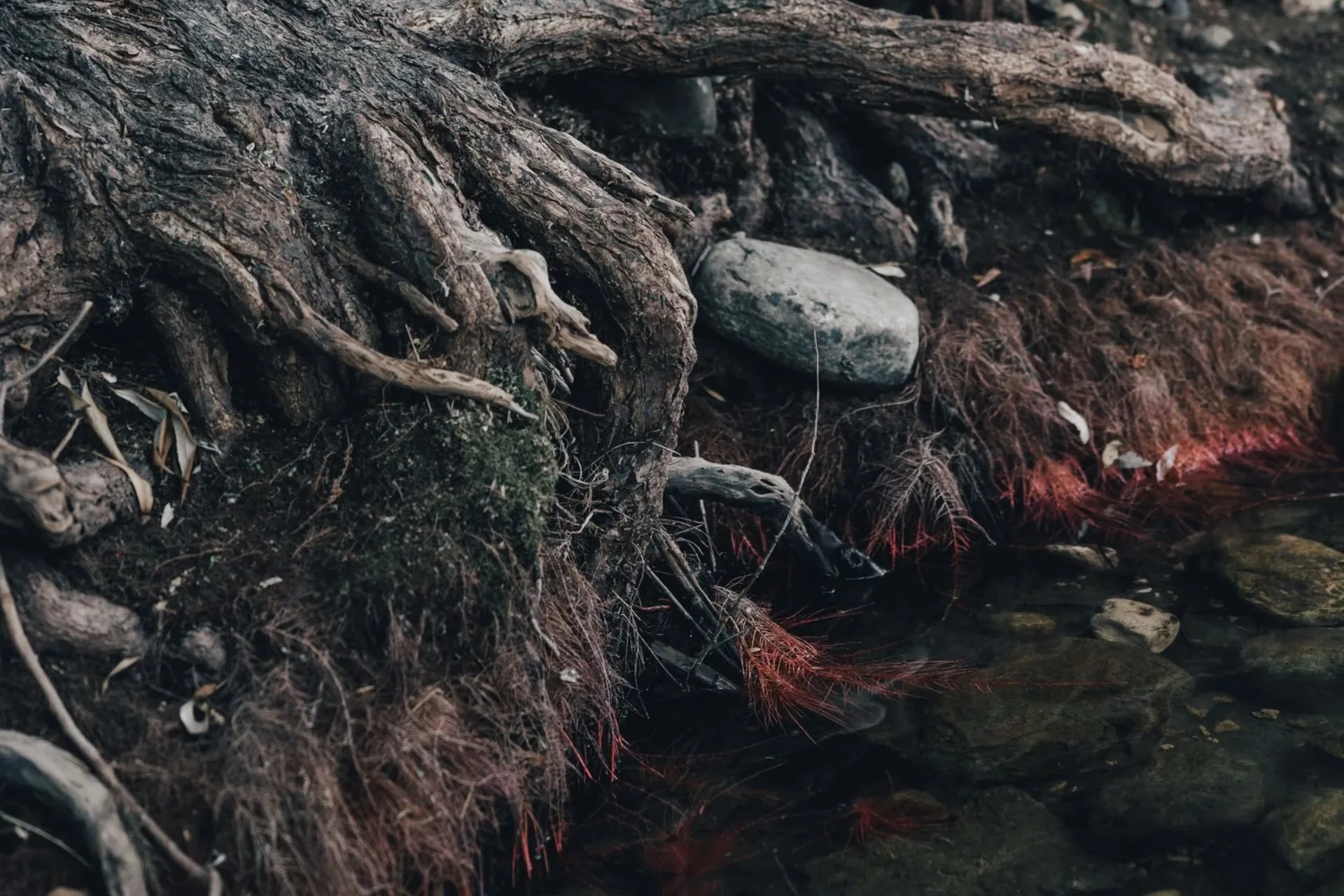
In modern global society, where we can work, share cat pictures and even publish books across continents, folk horror asks us to feel the stirring of our roots. They may twist up through the earth, wrap tight around our ankles and drag us down, or keep us grounded through the roar of bulldozers and shriek of chainsaws. They may offer us a lifeline.
Writing in the folk horror genre has allowed me to regrow parts of myself that I thought long dead. My childhood, while mostly spent in the city, was imbued with Peak District folklore. One of my earliest memories is seeing a black, panther-like creature dash across Burbage Moor. I’d listen out for the peals of drowned church bells in the flooded Derwent Valley, and peer into crevices in the limestone rock of Winnats Pass, hoping to catch a glimpse of the ghostly lovers who were robbed and butchered on their way to a secret wedding ceremony.
It was my parents’ move from Sheffield to Peak Forest that really connected me to past memories and living traditions. I first visited in December 2009, when snow, tinted lilac in the sunset, lay inches thick on gravestones in the village churchyard. We attended a carol service, expecting the usual renditions of ‘Hark, the Herald Angels Sing’ and ‘Silent Night’ and instead, heard a set of traditional Sheffield Carols that had been making the rounds in local pubs for 200 years. Although it was the first time I’d heard the hymns, their strangeness resonated deep in my bones.
When I began work on The Brink, unearthing the folklore of the Peak District, I awakened a connection to the land that felt profound and exciting. Here, all along, was a weirdness I could relate to. As part of my research, I discovered another Sheffield native and queer writer of horror tales, Robert Murray Gilchrist, who had lived for a time in an isolated house not far from my parents’. Through reading his letters at the Sheffield archives, I learned to love my city again and view the nearby Peak county as a place where anyone, no matter how far outside the social norms, could make a home. The process of writing has reinvested the landscape of my childhood with a magic that does not bind me to home, so much as make me appreciate how every place has a wealth of history lying just below the surface.
A few nights ago, I turned up at a folk music event in Cambridge, guitar in hand. As the established musicians raised the roof of the pub with Irish folk, English trad, Americana and Country, as familiar with their repertoire as with each other, I felt like a foreigner. Fumbling, I imitated what the other guitarists were playing.
This is not for you. You don’t belong here.
No one said these words to me. But my own mind decided I was an impostor, just as it decreed I’m no longer welcome in Sheffield.
Yet you become part of a community by doing. By excavating stories from the land. By joining in the songs that have been sung of old. All folk performances, including the telling of folk horror stories, are forged in a particular landscape but shared beyond it. Everybody hates a tourist. But who’s to say that if a tourist finds a part of themselves in a new landscape, or revives their old root system, they can’t expand or redefine their regional identity?
And so I hover on the border. My fingers get ready to dance. A tune rises to my lips. I wish to make an offering of my raw, oh-so-eager heart that will lead me back home, wherever I decide home will be.
Let me in, please. I have such tales to tell.