by Karen Heuler
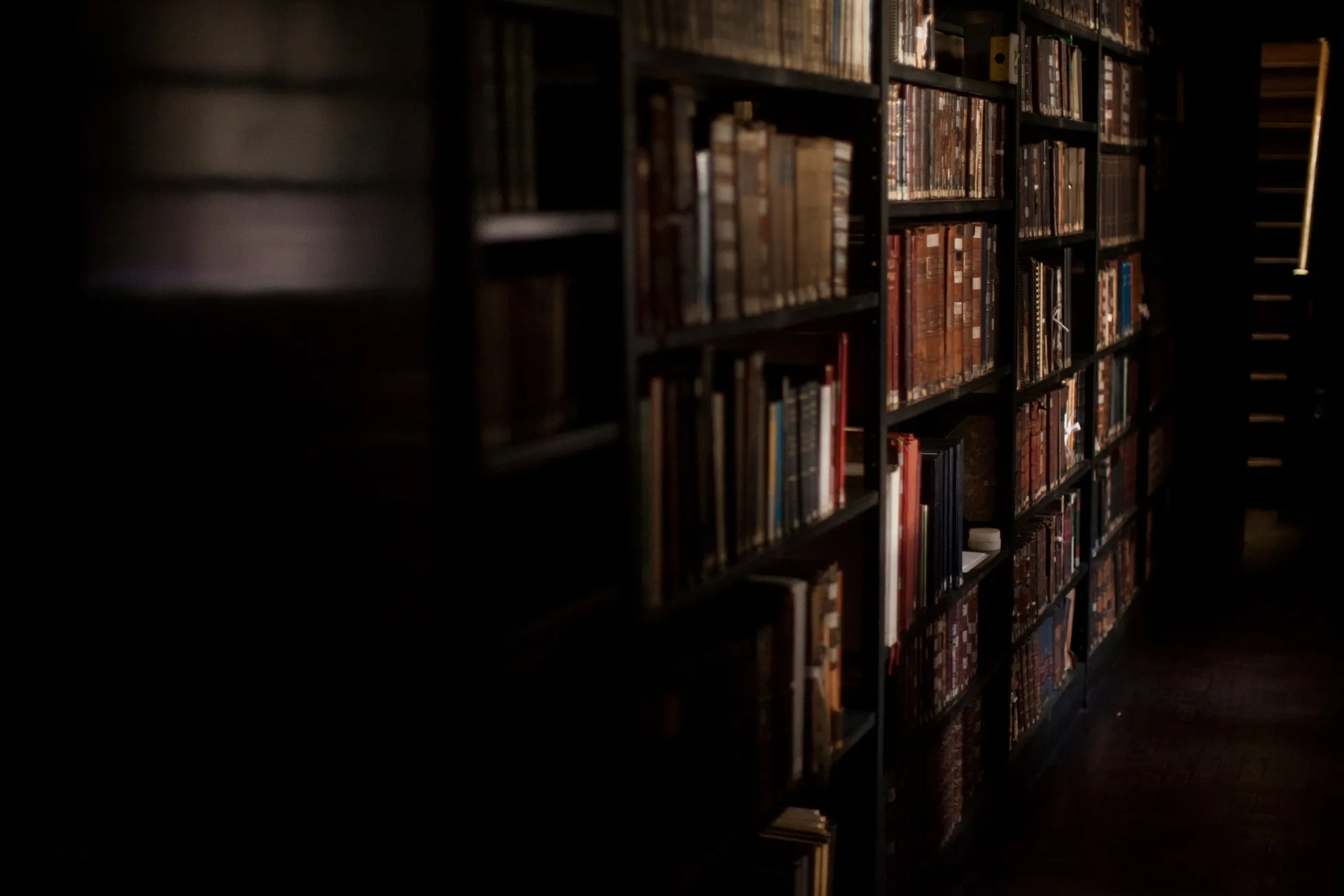
Imagine your books whispering to each other, shelf to shelf. Books do talk to each other, and they talk to you—because once you’ve read a book, it becomes in some small way a part of your life and experience. An image from a book, or a scene, or a character may pop up unexpectedly. You might find yourself saying, “I prefer not to,” and you can only hope that the person you’re speaking to has read “Bartleby, the Scrivener.” Or “So it goes,” and Vonnegut’s Slaughterhouse-Five. This quoting can become a kind of verbal shorthand, and it definitely becomes a mental one. A phrase from a book takes hold in your world.
As writers, we worry about whether we’re being truly original, or if we’re somehow plagiarizing another writer we’ve read over years and decades of reading. Helen Keller was accused of plagiarism, for instance, and some famous scandals over the years have exposed writers who lifted whole pages from other works. And in one recent case, even plagiarized the apology (Google “Jumi Bello”).
But I’m interested in those images and characters in our works that continue a conversation with characters in other books, especially “literary” ones. There’s been a longtime stiffness between literary and genre, and when a writer who’s known to be literary crosses over into genre territory, it gets handled in a different way than if genre crosses over to literary.
Which is preposterous. We’ve grown up on fairy tales, on Poe and Hawthorne and Kafka. Yet we classify imaginative tales as juvenile, and when Philip Roth (who wrote about a giant breast in The Breast, how ridiculous), writes The Plot Against America, some reviewers are amazed at his ingenuity. Alternate history—how clever!
Of course, alternate history is a staple in speculative fiction—see Philip K. Dick, for instance, in The Man in the High Castle (1962), or Colson Whitehead in The Underground Railroad. Wait, is Colson Whitehead literary? He should be careful he doesn’t go too far and become speculative.
Most libraries and bookstores have separate sections for Fiction and Science Fiction, on the theory that it makes it easier to find the kind (genre) of book you’re looking for. But does every book stay in its place? Jasper Fforde did a wonderful job of having the worlds of different classics become permeable in his Thursday Next series, with characters able to leap from one book to another, or steal or kill a character in another book. Not only are his books a fabulous read, but they also, to some extent, show how writers work. We leap and select from all the possibilities on the shelves and in our heads.
They call it homage when we do it knowingly—but how much homage is too much? How much shows lack of your own talent? It can make a writer’s pulse fluctuate.
Maybe I am, myself, a Jasper Fforde character, because I’m fine with inviting other people’s characters into my books—in slightly different forms. I just did that, in fact, but I changed the name and setting. If you don’t know The Master and Margarita by Mikhail Bulgakov, and you don’t know the devil’s companion, the black cat, Behemoth, then you might think my black cat is thoroughly original. Wait. He is original. Yes, his physical appearance is based on the cover of the original English translation of The Master and Margarita, but he’s swaggering down the streets of Liberty, not Moscow. And Liberty is not only the city I created, but it owes a lot to Omelas, Oz, and others. All of these pieces from other works that have inspired my creation of Liberty and Stan the cat and Eleanor the witch are like me writing a song. I’m using notes that have been used before, but not in this particular pattern.
This kind of literary kidnapping has been done before. Grendel is a monster in an old epic poem, who is killed by Beowulf. Then John Gardner wrote a novel from Grendel’s perspective. One of the most recent replays of this tale is told from Grendel’s mother’s perspective—The Merewife by Maria Dahvana Headley. Neither of these two reimaginings plagiarized Beowulf’s Grendel; they used the story as a starting point for a new perspective and a new interpretation of what a monster is.
For each new version, the political and personal vision changes. What was unquestioned in the original is reshaped by the perspective of the new. The outline is there, barely, like a chalk outline, but the actual victim gets redrawn by a new age.
The urge to break into classics is widespread—perhaps because something about them retains its meaning through each iteration. See Jeffrey Ford’s take on Ahab in Ahab’s Return, or Chandler Klang Smith referencing Jane Austen in her marriage proposal scene in The Sky Is Yours, or the many reworked fairy tale-inspired novels, each redrawing the conflicts and resolutions to a newer scale.
Some of the literary concerns do quite well in a fantastic setting. They always have, of course. We admire Poe, Kafka, Hawthorne, et al, and think of them as literary rather than speculative—perhaps because they’re seen as more engaged with moral questions than robots and ray-guns. Though Ray Bradbury as well as Isaac Asimov raise any number of moral questions in their stories, and Jeff VanderMeer is forcing us all to look at the environment and what we’re doing to it.
There are so many writers now who engage with morality and “the purpose of life” in speculative fiction—as, of course, was always true. It was true when Mary Shelley wrote Frankenstein in the 19th century..
What is making speculative more acceptable now? Literature began sliding down a slippery slope when magical realism blazed into American consciousness in the 1960s and 1970s. What a great liberation there was in that ability to make metaphors come alive! After that, more and more literary writers were drawn into the magical world of unrestricted imagination, and the outlawry continued, straight to science fiction and even (gasp) horror.
Magical realism loves metaphors that remind us of true life. All of the possibilities in fantasy, it turns out, can handle moral and political issues and those basic things like love and responsibility and loss and longing. Human things.
There have been essays written before about why someone would pick up a story that’s already been told, and retell it. The most obvious point, to me, is that a story may end but it is never finished. If you’re a writer, you may have been plagued by too many possible endings. If you’re a reader or a movie-goer, you may have come across unsatisfying or inconclusive endings. What satisfies one person may frustrate another, because the story itself has gone astray for some.
The Master and Margarita didn’t go astray for me. It opened up the way a story can be told. It delighted me. I loved the devil and his destructive companions, I loved the Russian literary scene; I loved the love story and will forever recall Margarita’s first flight as a witch.
The book gave me a starting point. The devil came to Moscow to sow even more disorder among the corrupt literary elite, accompanied by a disorderly group of companions. And that sarcastic cat, Behemoth. When people ask how I got the idea for a story, the only answer is, I just got an idea, that’s all—though sometimes it’s an image. It was that cover, the gun-toting, swaggering Behemoth, that suggested the tone, texture, and stunning egotism of Behemoth’s heir, Stan (who used to be a man), and that wonderful first ride on a broom in The Master and Margarita that gave me Eleanor, the novice witch who makes a mistake. The overweening egotism of some of the Russian writers also meshed well with the egotism of certain political figures. It’s a very different novel from Bulgakov’s. For one thing, Stan the cat is funnier than Behemoth. But as different as they are, I like to think of these two books chatting across the shelves, inviting other books to join in on the conversation. Catch-22? The Fifth Season? Perhaps they’ll break in on the discussion, or at the very least, wave from one book case to the next.